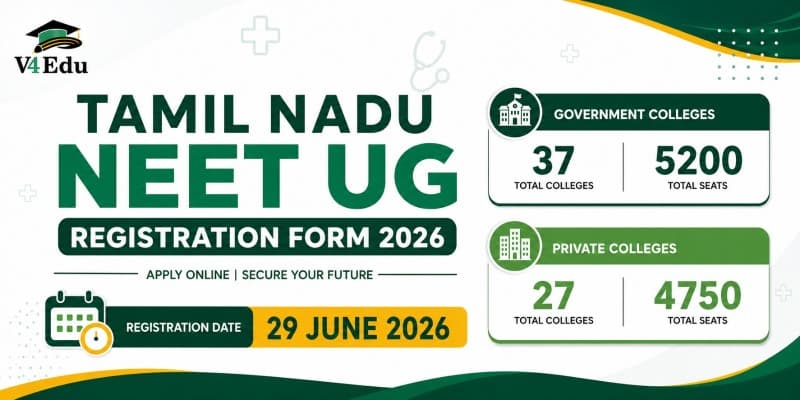
Karnataka NEET College Predictor 2026: Your Complete Guide to Predicting MBBS & BDS Admission
Confused about your NEET rank and which Karnataka colleges you might get? This guide breaks down everything about the Karnataka NEET College Predictor, including how it works, what to avoid, and tips from real experience to help you make the best choices.
 Sanjaypal
So you've got your NEET score, and now comes the real challenge — figuring out which college you can actually get into. If you're aiming for a medical seat in Karnataka, the Karnataka NEET College Predictor is one of the smartest tools you can use right now. It takes away a huge chunk of the guesswork and gives you a data-backed picture of where you stand.
Whether you're eyeing a seat at Bangalore Medical College, KMC Manipal, or one of the newer government colleges in the Hyderabad-Karnataka region, understanding how this predictor works — and how to use it correctly — can make a genuine difference in your counselling strategy.
This guide covers everything: how the Karnataka NEET College Predictor works, what inputs matter, top colleges to target based on your rank, common mistakes to avoid, and 20+ frequently asked questions to clear your doubts.
What Is the Karnataka NEET College Predictor?
The Karnataka NEET College Predictor is a digital tool — available on platforms like V4edu, Collegedunia and various ed-tech portals — that uses previous years' Karnataka counselling data to estimate which MBBS or BDS colleges you are likely to get admission into, based on your NEET UG rank, category, domicile, and preferred quota.
Put simply: you enter your details, and the predictor cross-references them against historical opening and closing ranks from KEA (Karnataka Examinations Authority) counselling rounds to generate a personalized college list.
Why Does This Tool Matter So Much?
Karnataka is one of India's largest states for medical admissions. With over 12,395 MBBS seats and 3,365 BDS seats spread across government, private, minority, and deemed universities, the sheer volume of choices can be overwhelming. A NEET College Predictor helps you:
• Narrow down realistic college options within seconds
• Avoid wasting choices during counselling on unreachable colleges
• Plan your strategy across multiple counselling rounds
• Compare government vs. private colleges on fees and eligibility
• Identify Safe, Target, and Reach colleges for your rank
How the Karnataka NEET College Predictor Works
The mechanics behind the Karnataka NEET College Predictor are rooted in historical data analysis. Here is a step-by-step breakdown of what happens under the hood:
Step 1: Data Collection from KEA & MCC
The predictor pulls opening and closing rank data from the last 3 to 5 years of KEA NEET UG counselling. This includes round-wise data — Round 1, Round 2, Mop-up Round, and Stray Vacancy — broken down by college, category, and quota type.
Step 2: Input Parameters You Provide
When you use the predictor, you typically enter the following information:
• Your NEET UG Rank or Score
• Category: General Merit (GM), SC, ST, OBC, EWS
• Domicile State: Karnataka domicile or non-Karnataka
• Preferred Quota: State Quota (KEA) or All India Quota (MCC)
• Preferred Course: MBBS or BDS
• Gender (some tools factor this in for seat matrix variations)
Step 3: Algorithmic Matching
The tool then compares your rank against historical cutoff data. Colleges are generally sorted into three buckets: Safe (your rank is well within the closing rank), Target (your rank is close to the cutoff), and Reach (the cutoff was tighter than your rank in past years).
Step 4: Results Display
You receive a list of colleges ranked by probability of admission, often accompanied by fee structures, seat availability, past cutoff trends, and quota-type breakdowns.
How to Use the Karnataka NEET College Predictor: Step-by-Step
1. Visit a trusted predictor platform such as V4edu.
2. Enter your NEET All India Rank (AIR) accurately — do not use your score alone if rank is available.
3. Select your category carefully (GM, SC, ST, OBC, EWS).
4. Choose your domicile: Karnataka or outside Karnataka.
5. Select the counselling type: KEA State Quota or MCC All India Quota.
6. Choose the counselling round (Round 1, Round 2, Mop-up) for targeted predictions.
7. Click 'Predict' and review the list of colleges generated.
8. Cross-check the results with official KEA cutoff data from the previous year.
9. Shortlist 10-15 colleges, balancing Safe, Target, and Reach categories.
10. Register on the KEA official portal at cetonline.karnataka.gov.in to begin formal counselling.
Understanding Karnataka's NEET Counselling Structure
Before diving deeper into predictor strategies, it helps to understand how seats are structured in Karnataka. This directly affects how you interpret predictor results.
Two Counselling Tracks for Karnataka
1. KEA State Quota Counselling (85% of Seats)
The Karnataka Examinations Authority (KEA) manages the 85% state quota seats. For the 2026 academic year, KEA oversaw counselling for approximately 9,282 MBBS seats across government and private colleges. To be eligible, candidates must meet one of KEA's seven domicile clauses (Clause A through G), which cover Karnataka natives, candidates who studied in Karnataka schools, children of Karnataka government employees, and more.
2. MCC All India Quota (AIQ) Counselling (15% of Seats)
The Medical Counselling Committee (MCC) handles approximately 3,113 MBBS seats under the All India Quota. These seats are open to candidates from any state in India, which generally means higher competition and tighter cutoffs than state quota seats.
Seat Types Under KEA Counselling
• Government Quota (G): Seats in government medical colleges and government share of private college seats.
• Private Seats (P): Seats in KPCF, AMPCK, and KRLMPCA private colleges.
• NRI Quota (N): Approximately 15% of seats in select private colleges, reserved for NRI students.
• Other/Q Seats: Special or supernumerary seats with comparatively relaxed cutoffs.
• Minority Seats: 25% of seats in minority colleges reserved under government quota.
Karnataka's Reservation Framework
Karnataka's seat allocation follows a defined reservation framework that the college predictor factors in:
• General Merit (GM): 44% of seats
• OBC Category: 15% of seats
• SC Category: 15% of seats
• ST Category: 3% of seats
• EWS Category: 10% of seats
• HK Region (Article 371J): 7% of seats across all state medical colleges, with 70% of seats in HK-region colleges reserved locally
Top Medical Colleges in Karnataka: What Rank Do You Need?
Here is a realistic breakdown of what rank you need to target some of Karnataka's most sought-after medical colleges based on 2025 counselling data:
Government Medical Colleges — High Competition Bracket
• Bangalore Medical College & Research Institute (BMCRI): AIR below 5,000 (GM category). Consistently the most competitive government college under AIQ.
• Mysore Medical College & Research Institute (MMCRI): AIR below 5,000-8,000 for top rounds.
• Karnataka Institute of Medical Sciences, Hubli (KIMS): Closing ranks historically between 8,000 and 25,000.
• JJM Medical College, Davangere: AIR range of 10,000 to 25,000 across rounds.
• Vijayanagar Institute of Medical Sciences (VIMS), Bellary: Mid-range closing ranks, accessible for candidates in the 15,000-30,000 bracket.
Private Medical Colleges — Wider Rank Bands
• Kasturba Medical College (KMC), Manipal: One of the most prestigious private colleges; management quota available for higher ranks.
• St. John's Medical College, Bangalore: Strong reputation; competitive cutoffs under state quota.
• MS Ramaiah Medical College: Popular choice; state quota cutoffs are competitive; management quota available.
• JSS Medical College, Mysore: Accessible under private quota for candidates with rank up to 50,000 and beyond.
Common Mistakes to Avoid When Using the Karnataka NEET College Predictor
Even with the best tools, students often make avoidable errors that cost them a seat. Here are the most common pitfalls — and how to sidestep them.
Mistake 1: Relying Only on the Predictor
The predictor is a guide, not a guarantee. Cutoffs shift every year based on the number of applicants, seat availability, policy changes, and even how many students opt out at the AIQ stage. Cross-reference predictor results with official KEA cutoff data.
Mistake 2: Ignoring the Domicile Clause
Many non-Karnataka candidates assume they can freely compete for 85% state quota seats. This is incorrect. KEA has clearly defined domicile clauses (A through G), and failing to qualify under any clause means you can only participate in the All India Quota or the open/Q seats of private colleges.
Mistake 3: Entering Category Details Incorrectly
Entering your category incorrectly — say, selecting General instead of OBC — will produce a completely wrong college list. Double-check your NEET scorecard and category certificate before using any predictor.
Mistake 4: Not Registering for Both KEA and MCC
Candidates eligible for both processes often skip MCC registration, leaving potential AIQ seats on the table. Register for both KEA and MCC counselling to maximize your options. Missing MCC registration deadlines is a costly and irreversible mistake.
Mistake 5: Overlooking the Mop-Up Round
Many students who do not get a seat in Round 1 or Round 2 give up on the process. The Mop-Up Round often reveals unexpected openings in both government and private colleges, particularly after candidates upgrade or cancel their seats. Keep monitoring KEA announcements through all rounds.
Mistake 6: Underestimating Private Colleges
Some students dismiss private colleges due to fees without exploring NRI quota, Q seats, or scholarship options. Many reputed private colleges in Karnataka have competitive cutoffs and excellent infrastructure. Do not rule them out without a full cost-benefit analysis.
Latest Updates and Trends for Karnataka NEET Admission 2026
• Total MBBS Seats: Karnataka offers 12,395 MBBS seats and 3,365 BDS seats across government, private, minority, and deemed institutions.
• Government MBBS Seats: 24 government colleges offer approximately 3,800 MBBS seats, with 85% reserved for Karnataka domicile candidates.
• KEA Seat Matrix 2026: KEA managed counselling for approximately 9,282 MBBS seats; MCC handled approximately 3,113 AIQ seats.
• Registration Reopening: KEA reopened NEET UG 2026 counselling registration for candidates who missed the initial window, with forms available July 7-17, 2026.
• HK Region Reservation: Under Article 371(J), 7% of seats in all Karnataka state medical colleges are reserved for the Hyderabad-Karnataka (HK) region, with 70% of seats in HK-region colleges reserved locally.
• Tightening Policies: Karnataka (alongside Assam) has been tightening its admission processes to improve fairness and transparency, per national education observers.
• Rising Competition: Cut-offs in top government colleges have continued to tighten year-on-year as NEET UG participation grows nationally.
• NRI Quota Expansion: NRI quota seats are now available in select government colleges in addition to private ones, offering a new avenue for eligible students.
Expert Tips to Maximize Your Karnataka NEET College Predictor Results
• Use Multiple Predictors: Run your rank through at least two or three predictor platforms to compare results. If a college appears across all platforms as a Safe pick, it is a strong candidate to prioritize.
• Check 3-Year Cutoff Trends: Look at cutoffs from 2023, 2024, and 2025 side-by-side. A college with consistently stable cutoffs is more predictable than one with wide fluctuations.
• Factor In Round-Wise Variation: Closing ranks loosen significantly from Round 1 to Round 2 to Mop-up. If you miss your preferred college in Round 1, stay in the process for later rounds.
• Prioritize Government Colleges: A government MBBS seat in Karnataka can cost as little as Rs 50,000 per year compared to Rs 8-25 lakh per year in private colleges. A Target government seat may be worth more than a Safe private seat financially.
• Do Not Skip Karnataka Domicile Verification: Ensure your domicile documents are ready before counselling begins. KEA strictly verifies eligibility, and document discrepancies can disqualify you from state quota seats.
• Keep Checking Official KEA Notifications: The KEA portal at cetonline.karnataka.gov.in is your primary source. Subscribe to SMS/email alerts and check regularly for seat matrix releases, round schedules, and any policy updates.
Latest Update
Tamil Nadu NEET UG Registration Form 2026
NEET UGRe-NEET 2026 Provisional Answer Key Released by NTA: Direct Link, Objection Process
NEET UGKarnataka MBBS Admission 2026: Private Medical Colleges List, Cutoff, Fees & Counselling
NEET UGKerala MBBS Admission 2026: Private Medical Colleges, Cut Offs, Fees & Counselling
NEET UGFrequently Asked Questions
What is a Karnataka NEET College Predictor?
How accurate are NEET College Predictors for Karnataka?
Is the Karnataka NEET College Predictor free?
Can I use a Karnataka NEET Predictor for private college admissions?
Do predictors consider reservation categories in Karnataka?
What details are needed to use a NEET College Predictor?
Can I trust the predictor if my score is borderline?
Are these predictors updated for 2024?
Do Karnataka NEET Predictors suggest colleges outside Karnataka?
How do I avoid mistakes when using a predictor?
Is the counseling process online for Karnataka NEET?
What happens if I miss a counseling deadline?
Are there new medical colleges in Karnataka for 2024?
Do NEET College Predictors cover BDS seats too?
Can I change my college preferences after using a predictor?
How many colleges should I list as options?
Do predictors consider state vs. All India quota?
Are private college cutoffs stable in Karnataka?
Can I get counseling help after using a predictor?
Does using a predictor affect my actual admission?
How soon after NEET results should I use a predictor?